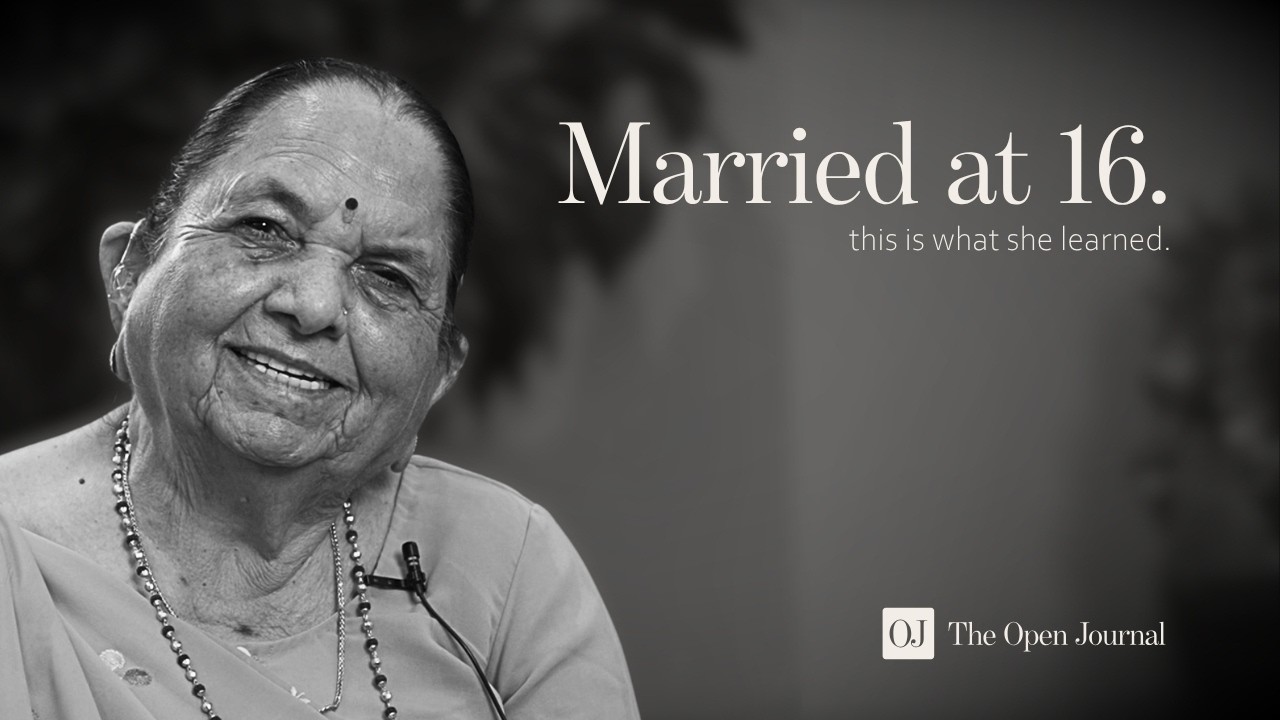
Married at 16 is a portrait film of Muktaben Mohanbhai Pankhania, filmed at 87. She was married at sixteen and raised a family of fifteen. In the film, she shares what a lifetime of love, loss, and family has taught her.
The film runs about 24 minutes, and you can watch it in full above. On YouTube it appears under the title Tejal’s Baa. It sits alongside the other films in our portfolio.
What the film holds
This is not her life story. This is her life’s meaning.
A life defined by resilience, migration, and the love that carried her through. That is how we describe it, and it is as close as a single line can get.
The facts are few, and they are enough. She was married at sixteen. She raised a family of fifteen. For decades, she served her elders without hesitation — and she would do it all again.
But the film is not a record of dates. It does not move in order from one milestone to the next. It stays with what she has come to know.
She speaks about three things. Put health before money. Respect the people around you. And the quiet power of simply saying Namaskar — a greeting, and its own kind of lesson.
None of these are new ideas. That is the point. They are what remains when a long life has tested everything else. Said at 87, they carry a weight no written list could.
How it was made
Every Open Journal film is led by listening, not biography. There are no scripts. There are no prompts. There is real conversation, and the time for it.
Pri directs every film, and studied psychology before he became a filmmaker. The first hour is simply a conversation. Nothing is asked for. Nothing is steered towards a soundbite.
Pri doesn’t arrive with a biography to fill in. The aim is not to get every date in order. It is to stay in the room long enough for the real story — which is often not the obvious one — to come forward.
What that makes room for is the pause. The moment before someone decides to say the true thing, rather than the expected one. A film about a life’s meaning, rather than its chronology, depends on that pause. You cannot script your way to it. You can only listen long enough for it to arrive.
Why a film rather than a written record
A family could write these lessons down. Health before money. Respect. Namaskar. On paper, they would fit on a single card.
What the paper cannot hold is her voice. The way she says it. The pace. The silences between the sentences. Reading “respect the people around you” is one thing. Hearing it from someone who served her elders for decades is another. That difference is the whole reason the film exists.
It is also for the people who haven’t even been born yet. They may know her name, and a few of her stories, but not her presence. A film gives them 24 minutes in the room with her. So they’ll know her. Even if they never meet her.
Written questions still matter — they are often where a film begins. If you are starting with your own parents, these questions to ask your parents about their life are a good place to begin. And if you want to understand the form itself, we have written about what a legacy film is.
Two other portraits
Muktaben’s film is one of three finished portraits. Left home at 7 is a portrait of Mahesh Gandhi, born in Nairobi in 1947. Building a life in England is a portrait of Bishnu Das, who arrived in England with ten pounds in his pocket.
Each is different in length and in shape. Each began the same way — with a conversation, and someone willing to listen.
Questions
What is a portrait film?
A portrait film is a director-led documentary about one person. It is shaped around what they have come to understand, not only the events of their life. The Open Journal makes portrait films as heirlooms, to be watched by the generations that follow.
How long is the film?
The film runs about 24 minutes. On YouTube it appears under the title Tejal’s Baa.
How was the film made?
Through conversation. There were no scripts and no prompts. Pri directs every Open Journal film and studied psychology before he became a filmmaker. The first hour is simply a conversation.
Who commissions films like this?
Adult children and grandchildren who want a parent’s or grandparent’s voice kept properly. Partners, for an anniversary. Sometimes people commission a film of their own life. Commissions start from £2,250.