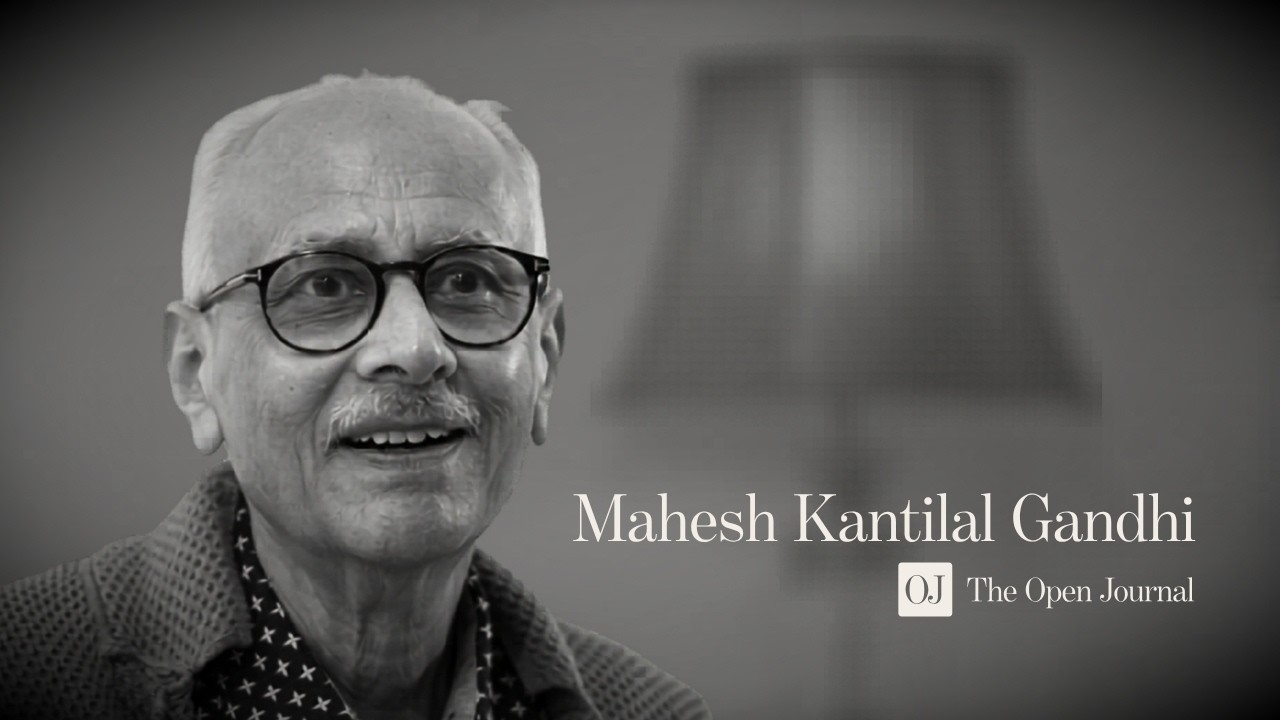
Left home at 7 is the full-length portrait film of Mahesh Kantilal Gandhi, born in Nairobi in 1947. At seven, a cousin’s promise of daily ice cream was enough to send him to Dar es Salaam — and he never told his uncle he wanted to go home. The film holds a life shaped by quiet obedience, quiet resilience, and quiet grief, and by what carried him through.
You can watch the film above. It sits alongside the other portraits in our portfolio.
What the film holds
The ice cream never came. And he couldn’t bring the words out.
It is a small moment. It says a great deal. Not the promise, or the ice cream that never arrived, but the silence afterwards. A seven-year-old who kept it to himself.
He was raised by relatives in a two-bedroom flat. He became a pharmacist in London. His father bought a house at auction without seeing it. Here, each of these is a single line. Each could hold an afternoon of its own.
He lost his daughter, Komal, in a car accident when she was 19. Some things are not ours to summarise.
What carried him was family, faith, and community. And a motto from his father, given over coffee in Nairobi: look after your sisters, no matter what.
Quiet obedience. Quiet resilience. Quiet grief. The word keeps returning in how this life is described. It is the right word.
How it was made
Every Open Journal film is led by listening, not biography. No scripts. No prompts. Real conversation.
That matters most with stories that were never said out loud at the time. Some things take a long while to find their words. A list of questions, asked on cue, does not get there.
Pri directs every film, and studied psychology before he became a filmmaker. The first hour is simply a conversation. Nothing is rushed towards a point. The silence is allowed to sit.
There is no chronology to work through, and no order the answers have to arrive in. Some of what matters only surfaces after a long time talking. The work is to still be listening when it does.
Why a film rather than a written record
A written record could list the facts. Nairobi, 1947. Dar es Salaam at seven. A two-bedroom flat. Pharmacist, London.
What it cannot hold is how he tells it. The voice. The face. A father’s words over coffee in Nairobi, heard from the son who was given them. The difference between a fact and a voice.
For the people who haven’t even been born yet, the facts will likely survive anyway. They are the kind of thing families write down. His voice will not, unless someone records it properly.
The people who come after will want more than dates. They will want to know what it was to be seven, far from home, and unable to say so. Only he can tell them that. A film is how it stays told.
If you are thinking about the same for someone in your own family, we have written about what a personal documentary is, and about the questions to ask your parents about their life before anyone picks up a camera.
Two other portraits
This is one of three finished portraits. Married at 16 is a portrait of Muktaben Pankhania, filmed at 87. Building a life in England is a portrait of Bishnu Das, born in undivided Bengal in 1943.
Three lives, three different lengths. None of them began with a script.
Questions
What is a portrait film?
A portrait film is a director-led documentary about one person. It is shaped around what they have come to understand, not only the events of their life. The Open Journal makes portrait films as heirlooms, to be watched by the generations that follow.
How long is the film?
This is the full-length film. It runs about three and a half hours.
Who is Mahesh Gandhi?
Mahesh Kantilal Gandhi was born in Nairobi in 1947. At seven, he went to Dar es Salaam. He was raised by relatives in a two-bedroom flat, and later became a pharmacist in London.
Who commissions films like this?
Adult children and grandchildren who want a parent’s or grandparent’s voice kept properly. Partners, for an anniversary. Sometimes people commission a film of their own life. Commissions start from £2,250.