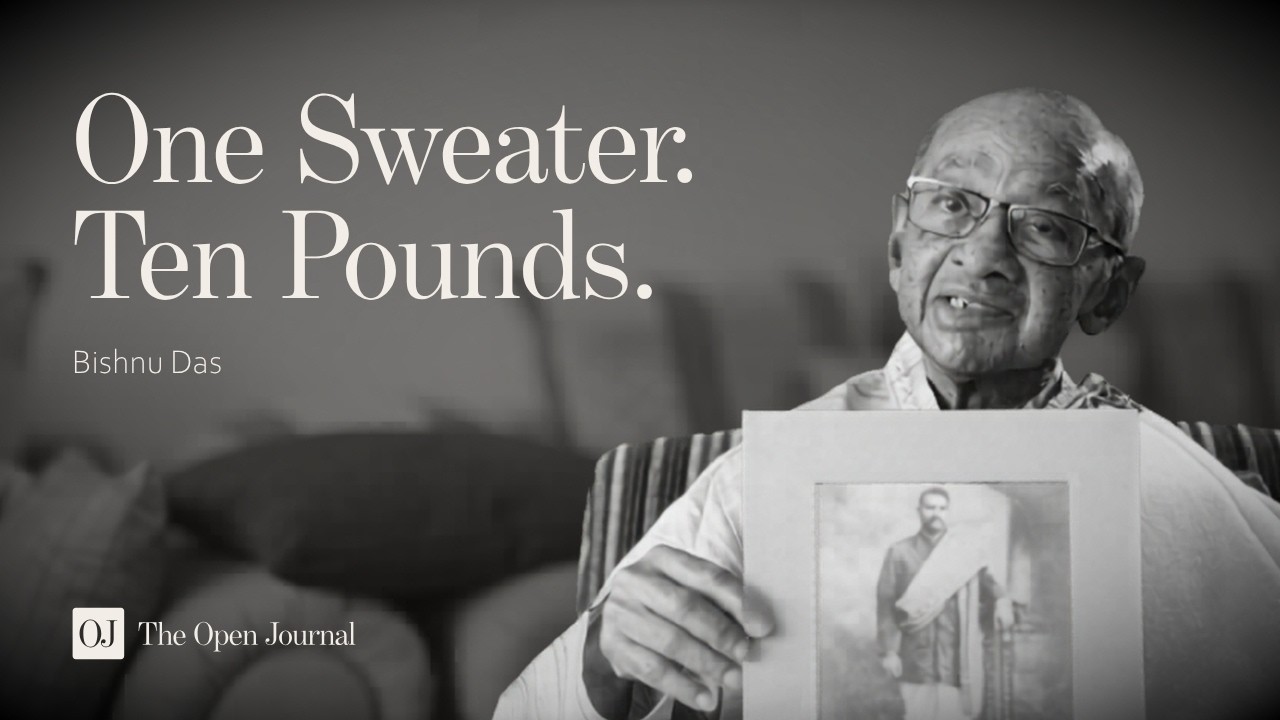
Building a life in England is a portrait film of Bishnu Das, born in 1943 in a Rajbari — a mansion — in undivided Bengal. Partition took his family’s home, their business, and their world. The film holds what it took to rebuild a life from scratch.
It runs about an hour and twenty minutes, and you can watch it in full above. It sits alongside the other portraits in our portfolio.
What the film holds
Elephants at the gate. Armed guards at the entrance. A grandmother who played piano in the ballroom.
That is the world he was born into.
Then Partition changed everything. The family lost their home. They lost their business. They lost their world.
What followed was study. Calcutta. Then IIT Kharagpur. Then a PhD in Bradford. He arrived in England with one sweater, one jacket, and ten pounds in his pocket.
In the film, he shares what it took to rebuild. The racism he faced in silence. The community he found. The faith that carried him. And the pride of doing it through hard work.
The list ends with pride. That is worth noticing. A life that began with a ballroom began again with ten pounds. What was taken is part of it. What was built is part of it too.
How it was made
Every Open Journal film is led by listening, not biography. No scripts. No prompts. Real conversation.
Things faced in silence are often the hardest to say. They need a listener, not an interviewer. Someone willing to wait.
Pri directs every film, and studied psychology before he became a filmmaker. The first hour is simply a conversation. There is no list to get through. There is no answer the film needs to hear.
A life with this many chapters tempts an interviewer to march through them in order. We don’t. The chapters are there. What we listen for is what sits between them — the thing a person has carried for years without being asked.
That is how a life of this range — a Rajbari, Partition, Calcutta, Kharagpur, Bradford — can be held in a single film without being flattened into a timeline. The facts are there. But the film is shaped around what they meant to him.
Why a film rather than a written record
A life like this could fill a book. Partition fills whole libraries. What it meant to one family, told by someone who lived through it, is rarer.
But a book cannot hold a voice. It cannot hold the pace of someone remembering, or the silence before a hard sentence, or the face of the person who lived it. What a written record gives you is the story. What a film gives you is the person telling it. A book can record ten pounds. A film lets you sit with the man who arrived carrying them.
It is also for the people who haven’t even been born yet. They will inherit the facts — the mansion, the elephants, the arrival in England. A film lets them inherit his presence too. So they’ll know him. Even if they never meet him.
If you are thinking about the same for someone in your own family, we have written about what a legacy film is, and about what a personal documentary is.
Two other portraits
This is one of three finished portraits. Married at 16 is a portrait of Muktaben Pankhania, filmed at 87. Left home at 7 is a portrait of Mahesh Gandhi, born in Nairobi in 1947.
Different lives, different lengths, the same way of working. Listening first, and for as long as it takes.
Questions
What is a portrait film?
A portrait film is a director-led documentary about one person. It is shaped around what they have come to understand, not only the events of their life. The Open Journal makes portrait films as heirlooms, to be watched by the generations that follow.
How long is the film?
The film runs about an hour and twenty minutes.
Who is Bishnu Das?
Bishnu Das was born in 1943 in a Rajbari, a mansion, in undivided Bengal. After Partition, he studied his way from Calcutta to IIT Kharagpur to a PhD in Bradford, and rebuilt his life in England.
Who commissions films like this?
Adult children and grandchildren who want a parent’s or grandparent’s voice kept properly. Partners, for an anniversary. Sometimes people commission a film of their own life. Commissions start from £2,250.